
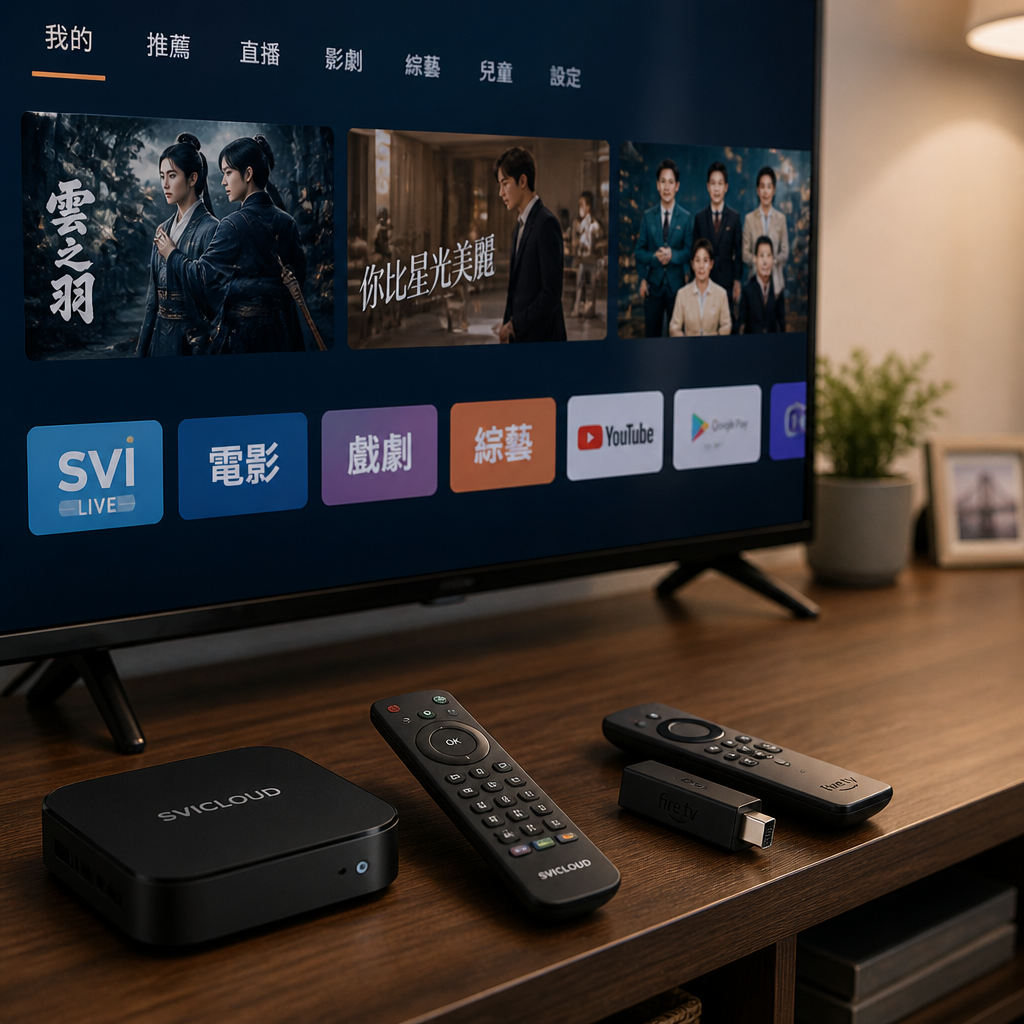
When choosing a streaming TV device in the United States, many Chinese-speaking families often hesitate between SVICLOUD TV Box vs Fire TV Stick. Both can turn a TV into a more convenient entertainment hub, but their design logic, usage habits, and support options are actually not exactly the same.
If what matters to you is not just “can it play,” but whether it is easy for family members to use, whether the Chinese interface feels intuitive enough, whether setup is too troublesome, and whether someone can help in Chinese when problems come up, then it is even more worth comparing carefully before deciding which kind of product is more suitable for your household.
Let’s start with the conclusion: which is better for you, SVICLOUD TV Box or Fire TV Stick?
If you just want the key point first, the answer is not simply which one is “stronger,” but which one fits your usage scenario better.
If you care about a Chinese interface and local customer support, which type should you look at first?
For many Chinese-speaking families living in California, New York, or Texas, the hardware itself is not the only concern. Being able to quickly enter a familiar Chinese operating environment often has a bigger impact on the actual day-to-day experience.
If your household has the following situations, SVICLOUD TV Box is usually worth considering first:
- Elderly family members will also use the TV
- You want Traditional Chinese as the main operating language
- You do not want to rely on English guesswork every time you set things up
- When problems happen, you want to be able to find Chinese-language support in the United States
- You want the device to serve as a shared family entertainment center, not just for one person
If you want to learn more about the positioning of the SVICLOUD lineup and the confirmed features, you can first refer to SVICLOUD plan comparison.
If you are already used to the Amazon ecosystem, what are the advantages of Fire TV Stick?
In terms of positioning, Fire TV Stick is more oriented toward the Amazon ecosystem and mainstream international streaming needs. If you already use an Amazon account, are used to an English interface, and mainly watch mainstream international video platforms, then its operating logic will usually feel closer to your existing habits.
For this type of user, the advantages of Fire TV Stick often include:
- Already being familiar with Amazon accounts and related services
- Mainly watching English content or mainstream international platforms
- Being comfortable with the system and menu logic
- Being willing to spend some time logging in and setting preferences yourself
This does not mean it is not suitable for Chinese-speaking families. Rather, if your daily entertainment center is already built around English interfaces and international services, Fire TV Stick may simply feel more natural to use.
If you want more complete hardware specs and a better family usage experience, what can SVICLOUD TV Box offer?
If you care not only about the interface but also about the device’s specs and connectivity flexibility, then some SVICLOUD TV Box models offer more room for comparison. Based on the confirmed information on the SVICLOUD 15P official product page, SVICLOUD 15P includes:
- Android 14
- Amlogic S905Y5 quad-core ARM Cortex-A55
- 4 GB DDR3 RAM
- 64 GB eMMC storage
- Dual-band Wi-Fi 6
- Bluetooth 5.4
- HDMI 2.1
- RJ45 wired network
- Bluetooth voice remote
- 4K HDR
- AV1 hardware decoding
From a factual standpoint, different products naturally differ in system, ecosystem, operating logic, support methods, and hardware configuration. From a user’s perspective, which is more convenient for a Chinese-speaking family usually depends less on a single spec and more on what matters most to you:
- Chinese interface
- How apps are obtained
- Whether family members can use it easily
- Installation and setup difficulty
- U.S. local customer service and warranty support
---
First, understand the difference in positioning between the two
Before talking about “which is better,” it is more important to understand first: SVICLOUD TV Box and Fire TV Stick are positioned differently. Different positioning leads to different day-to-day experiences.
Fire TV Stick’s positioning: centered on the Amazon ecosystem and general streaming needs
Generally speaking, Fire TV Stick is often seen as a device that acts as an entry point to mainstream streaming services. Its core value is usually to let users quickly access common video apps and related services through a familiar platform and account system.
If your life already relies heavily on English systems, Amazon accounts, and international services, this positioning will feel natural. You do not need to build a new set of habits from scratch; instead, you continue using a method you already know.
SVICLOUD TV Box’s positioning: centered on family entertainment use and Chinese-speaking habits
By contrast, SVICLOUD TV Box is more often used by Chinese-speaking families as a shared home entertainment device. The focus of this positioning is not only on “what can be installed,” but also includes:
- Whether the interface matches Chinese reading habits
- Whether it is easy to teach family members to use
- Whether switching content daily is smooth
- Whether help is easy to communicate when needed
If the people using the device in your home are not just you, but also your spouse, children, and elders, this difference becomes very noticeable.
Why “different positioning” affects the daily experience
Many people first look at the appearance or price range, but overlook the fact that the home screen design, search method, language switching, app acquisition flow, and remote control logic are what you will actually interact with every day.
Here are some common differences:
| Comparison aspect | Fire TV Stick | SVICLOUD TV Box |
|---|---|---|
| Overall positioning | Focused on Amazon ecosystem and general streaming | Focused on family entertainment and Chinese-speaking habits |
| Usage context | Easier for English-interface users to continue familiar habits | Easier for Chinese-speaking families to adapt quickly |
| Family sharing experience | Depends on whether family members are familiar with the system | More friendly for families that value Chinese operation |
| Support considerations | Depends on the brand’s support approach | If you value Chinese support in the U.S., it is usually worth comparing |
One thing to note: no single positioning is automatically better for everyone. What really matters is whether you can use it easily every day after bringing it home.
---
Comparison point 1: App ecosystem and whether the content you watch is easy to find
When many people compare devices, the first question is: “Which one has more apps?” But for most households, the real question should be: Is the content I usually watch easy to find, easy to enter, and easy for family members to use?
What the Fire TV Stick app ecosystem looks like
From a general usage perspective, Fire TV Stick is more suitable for:
- People who mainly watch mainstream international streaming content
- People who are used to finding apps through an English interface
- People who are already familiar with the Amazon ecosystem
- People willing to manage accounts, downloads, and settings themselves
Whether common apps are easy to access will still be affected by your regional settings, usage habits, and account environment. So when comparing, it is not recommended to rely only on other people’s experiences; instead, list the content sources you use most often first.
Key points of the SVICLOUD TV Box app experience
For Chinese-speaking families, what is often valued about SVICLOUD TV Box is not necessarily “how many apps it can install,” but whether Chinese content entry points are more intuitive and whether the overall operation better matches Chinese usage logic.
This is also a key point many families notice when comparing: What really affects the experience is not just the number of apps, but also:
- Whether the content you watch often is easy to find
- Whether family members can understand the categories
- Whether search and switching feel intuitive
- Whether different age groups can get used to it quickly
If you want to learn more about the usage scenarios of different models, you can refer to SVICLOUD plan comparison.
The most common problems for Chinese-speaking families
For Chinese-speaking families living in the United States, the common issue is not that the device cannot be used at all, but that it does not feel smooth enough to use. For example:
- Not being able to find a familiar Chinese content entry point
- App layout being different from what you are used to
- Search logic not matching Chinese usage habits
- New users not knowing which settings to do first
- Elderly family members seeing the English interface and giving up immediately
These issues may seem like just “not being used to it,” but for a shared family device, they become a usage barrier over time.
How to tell which app ecosystem you need more
You can ask yourself a few questions first:
- Do I mostly watch Chinese content or mainstream international platforms?
- Is there anyone in the family who only understands Chinese?
- Am I willing to spend time researching the settings myself?
- Is this for me alone, or for the whole family?
- Do I care more about platform integration or about smooth Chinese operation?
If your answers lean toward the following:
- Often watching Chinese programs
- Used to a Traditional Chinese interface
- Wanting family members to pick it up easily
- Wanting to reduce the learning cost
Then SVICLOUD TV Box is usually worth prioritizing. If you want to check the confirmed specs and information for 15P, you can directly view the SVICLOUD 15P official product page.
---
Comparison point 2: Chinese interface and how difficult it is for family members to get used to
For many Chinese-speaking families, the interface language is not a small detail; it is a core experience felt every day. Especially when the device is used by more than one person, how intuitive the interface is is often more important than how many items there seem to be in the menu.
Is the Fire TV Stick interface suitable for Chinese-speaking families?
From a user experience perspective, if you are already used to an English interface, then the Fire TV Stick home screen, settings, and app search methods may not be difficult for you.
But for some family members, especially:
- Family members who do not often use technology products
- People who are used to reading in Chinese
- Older users
An English interface may increase the adjustment time. This does not mean Fire TV Stick is necessarily hard to use, but the language barrier directly affects learning speed and confidence in operation.
Why the Chinese-language experience of SVICLOUD TV Box is often valued
One reason SVICLOUD TV Box gets attention from Chinese-speaking families is that it is easier to place into a “the whole family can use it” scenario. When the interface, instructions, and communication can all be centered on Chinese, the overall mental burden drops a lot.
This kind of advantage is usually reflected in:
- Traditional Chinese being more intuitive to read
- Family members being able to teach each other more easily
- Elders being less likely to reject it because of the English interface
- When there is a problem, it is easier to explain clearly in Chinese
For Taiwanese, Hong Kong, Macau, and other Chinese-speaking families, this is not just a language preference, but a difference in overall usability.
For elders, which type of interface matters more?
If there are elders in the household, the buying criteria are usually different from those of younger users. What elders care about is often not how many features are new, but:
- Whether the text is clear
- Whether categories are easy to find
- Whether the steps are few
- Whether the remote is intuitive
- Whether it keeps jumping around so that they do not know where they are
This is why many families end up choosing not the device with the “most features,” but the one that is “least likely to make family members give up.”
If you are not the only one using it at home, interface choice matters even more
Many people choose a device based on their own level of familiarity. But after bringing it home, they realize that the people who actually use the TV most may be a spouse, parents, or children.
The most important principle for a shared family device is very simple:
- It is not just whether you can use it
- It is whether everyone can operate it smoothly
If the device always requires you to act as the family’s technical support, that usually means it is not well suited for shared use.
If you need further Chinese-language help, you can check U.S. customer service and after-sales support for the official contact method.
---
Comparison point 3: Setup difficulty and the first installation experience
The feeling during first installation often determines your impression of the device afterward. For busy office workers, people who just moved, or people who do not want to study too many settings, whether the initial setup can be completed smoothly matters more than many advanced features.
What steps are usually involved in the initial Fire TV Stick setup?
In a general streaming device setup process, initial setup usually includes a few basic steps:
- Connecting to the TV via HDMI
- Connecting to the home network
- Logging in to an account
- Completing basic preference settings
- Downloading or organizing frequently used apps
If you are already familiar with related systems, these steps are usually not too difficult. But if you want to “plug it in and start watching as soon as possible,” then every login, switch, and preference setting can become extra time cost.
What is the key to the initial setup experience of SVICLOUD TV Box?
From a Chinese-speaking family perspective, one of the attractions of SVICLOUD TV Box is: whether it can get you into a familiar Chinese-language environment faster. For families using a TV box for the first time, this directly affects the overall feeling.
When the setup flow matches your language and usage logic more closely, there are usually a few benefits:
- You are less likely to get stuck on screens you cannot understand
- Family members can complete the setup together
- The later teaching cost is lower
- The sense of “set it up and it works” comes faster
Which is better for people who do not want to spend much time researching?
If you are in one of the following usage scenarios, whether setup is simple becomes very important:
- Office workers who just want to start watching quickly after work
- Elderly family members who want to learn fewer new operations
- People who recently moved to the U.S. and want to keep their original Chinese viewing habits
- People who do not want to research the setup again every time a problem occurs
In this situation, it is recommended to treat “how smooth the first setup is” as a major comparison criterion, rather than only looking at brand awareness.
Things to check before setup
No matter which device you ultimately choose, it is recommended to check the following before installation:
- Whether the TV has an available HDMI port
- Whether the home Wi-Fi is stable
- Whether family members mainly use Chinese or English
- Whether a wired network option is needed
- Whether the TV placement makes cable connection convenient
- Whether the remote needs to be simple and intuitive to use
If you care about flexibility in connection methods, the confirmed features of SVICLOUD 15P include dual-band Wi-Fi 6 and RJ45 wired network, which can be a practical reference point for some households that value stable connectivity. The relevant confirmed specs can be found on the SVICLOUD 15P official product page.
If you want to read common setup questions first, you can also check SVICLOUD FAQ.
---
Comparison point 4: Customer support and after-sales protection
When many people buy a streaming device, they focus on “before buying” but overlook what often affects the experience most: “after buying.” Especially for Chinese-speaking families, whether customer support can communicate and whether after-sales service is clear is often more practical than paper specs.
Why local customer support in the U.S. matters so much for Chinese-speaking families
Chinese-speaking families living in the U.S. face a very real situation: even if the device itself is not complicated, when you run into installation, language settings, remote pairing, network connection, or usage questions, processing the issue is usually much slower if you cannot describe it clearly in a language you are comfortable with.
The importance of U.S. local customer support is usually reflected in:
- Being able to explain the problem in Chinese
- Better understanding of the U.S. home network and TV environment
- Lower communication costs
- Clearer processes when after-sales support is needed
For areas with many Chinese-speaking families, such as California, New York, and Texas, this point is especially easy to value.
The value of the SVICLOUD brand in local U.S. support
According to publicly available information on this site, SVICLOUD emphasizes U.S. local customer service and after-sales support, and SVICLOUD 15P comes with the same approved one-year U.S. warranty. For many families, this represents not just “there is a warranty,” but that when you truly need help, you may have a better chance of getting support that is closer to the local usage context.
If you especially care about after-sales assistance, you can directly use U.S. customer service and after-sales support to arrange Chinese-language help for installation or warranty-related issues.
When comparing Fire TV Stick and SVICLOUD TV Box, what should you look at in after-sales service?
When comparing after-sales support, do not just look at brand recognition. Look at these more practical questions:
- When there is a problem, who do you contact?
- Can the issue be handled in a language you are comfortable with?
- Is there a clear official contact channel?
- Is the warranty and FAQ documentation easy to find?
- Do you want to research it yourself, or do you want someone to help?
There is no absolute standard for these conditions, but for many Chinese-speaking families, Chinese-language support and U.S. local service are clear advantages.
After-sales support is not only about fixing faults, but also about everyday peace of mind
Many people think after-sales matters only when the device breaks. In fact, for home use, the value of after-sales support also lies in:
- Being able to ask for help when first installation gets stuck
- Having someone to ask when a setting is unclear
- Being able to quickly find direction when family members have questions
- Knowing where to start when upgrading models in the future
If you are comparing the positioning and scenarios of different models, it is recommended to also look at SVICLOUD plan comparison and SVICLOUD FAQ.
---
Hardware and everyday use: what can be clearly compared about SVICLOUD TV Box?
If you are the type of person who looks at specs, then among the SVICLOUD lineup, SVICLOUD 15P is a model for which confirmed specifications can be clearly referenced. This section does not use it to infer competitor details, but simply helps you understand: how specs affect the family usage experience.
Key confirmed specs of SVICLOUD 15P
According to the official product page, SVICLOUD 15P includes:
- Android 14
- Amlogic S905Y5 quad-core ARM Cortex-A55
- 4 GB DDR3 RAM
- 64 GB eMMC storage
- Dual-band Wi-Fi 6
- Bluetooth 5.4
- HDMI 2.1
- RJ45 wired network
- Bluetooth voice remote
- 4K HDR
- AV1 hardware decoding
See more here: SVICLOUD 15P official product page
What do these specs mean for an average household?
The specs are not the goal; the key is the usage scenarios they create. For example:
- 4 GB RAM / 64 GB storage: More useful for households that install multiple common apps and want the device to keep more space available.
- Wi-Fi 6 and RJ45 wired network: If your home network environment is complex, or if the TV’s location makes wired networking convenient, connectivity flexibility is higher.
- Bluetooth voice remote: Practical for people who do not want to type much and want more intuitive control.
- HDMI 2.1, 4K HDR, AV1 hardware decoding: Worth noting for users who care about picture performance and support for next-generation video formats.
Of course, specs alone do not represent everything. You still need to return to your own family situation: Do you want a device with attractive specs, or one that the whole family is willing to open every day?
Who will care especially about hardware specs?
You may care more about these confirmed specs if you are the kind of user who:
- Wants the device to remain flexible throughout its useful life
- Compares connection methods and ports
- Has diverse home entertainment needs
- Cares not only about the interface but also the overall configuration
If you just want to get started quickly, you do not necessarily need to study every spec in detail. But if you naturally look at device configurations, then SVICLOUD 15P at least provides more complete and verifiable information.
---
Which is more suitable for Chinese-speaking families in California, New York, and Texas?
Although the device itself does not change by state, different lifestyles in different regions do affect what you value.
California families: value multilingual environments and shared family use
Many Chinese-speaking families in California already live in a multilingual environment. Work during the day, children at school, and different usage habits among elders often make device selection lean toward:
- Whether the Chinese interface is clear
- Whether family members can operate it themselves
- Whether customer service can explain things in Chinese
- Whether setup does not take too much time to study
In this situation, SVICLOUD TV Box is often considered not because of a single feature, but because of the overall coordination of family use.
New York families: limited space, precious time, so setup efficiency matters more
Life in New York moves fast, and many families care more about not wasting time. If you just want to relax after work, whether the device can quickly enter familiar content after installation becomes very important.
This kind of scenario is especially suitable for comparing first:
- Whether initial setup is easy
- Whether home network and device connection are convenient
- Whether common content entry points are intuitive
- Whether help can be found quickly when problems occur
Texas families: living-room usage scenarios and stable connectivity are often important
In some Texas households, the living room is larger and the device is often the center for family viewing. In this case, besides the interface and content, people may care more about:
- Whether Wi-Fi is stable
- Whether wired networking is needed
- Whether the remote is easy to use
- Whether long-term daily use is convenient
If you have these needs, the fact that SVICLOUD 15P includes Wi-Fi 6 and RJ45 wired network is a more concrete comparison point.
---
In the end, how do you choose? Use this table for a quick summary
If you are still hesitating after reading this far, you can use the simple table below to organize your priorities.
| Your priority | More likely fit |
|---|---|
| Already used to the Amazon ecosystem and English interface | Fire TV Stick can be considered first |
| Want a more intuitive Chinese interface and easier family use | SVICLOUD TV Box is worth prioritizing |
| Have elders using it at home | SVICLOUD TV Box usually fits better |
| Want the device to serve as a shared family entertainment center | SVICLOUD TV Box is often considered |
| Care more about the usage habits of mainstream international platforms | Fire TV Stick may better match the existing ecosystem |
| Care about U.S. local Chinese-language customer support and after-sales service | SVICLOUD TV Box has clear comparison value |
| Want clearly verifiable confirmed specs | See SVICLOUD 15P directly |
A simple decision rule
You can remember it this way:
- If you care about ecosystem continuity and English operation habits: start with Fire TV Stick
- If you care about a Chinese interface, family sharing, and local Chinese support: start with SVICLOUD TV Box
This is not an absolute conclusion, but a more efficient buying direction.
---
Next step recommendation: look at the model first, then customer service and FAQs
If you are leaning toward SVICLOUD TV Box, the next step is not to focus only on a single selling point. Instead, first look at model differences, customer support, and common questions all together, so you are less likely to buy something that does not fit your family’s needs.
You can start from these official pages:
- View the confirmed specs and product info: SVICLOUD 15P official product page
- Compare the usage scenarios of 15P, 10P+, and 10S: SVICLOUD plan comparison
- Learn about Chinese customer support, installation help, and warranty contact methods: U.S. customer service and after-sales support
- Read common setup and purchase questions first: SVICLOUD FAQ
- Go back to the official website homepage for complete information: SVICLOUD U.S. official website
If your core needs are a Chinese interface, easy family use, and the peace of mind brought by U.S. local Chinese support and a one-year U.S. warranty, then SVICLOUD TV Box is definitely worth putting on your priority comparison list. On the other hand, if you already use the Amazon ecosystem deeply and the people in your household can accept English operation, Fire TV Stick may still be the choice that better fits existing habits. The truly best choice is not which one the internet says is strongest, but which one best fits those few minutes every day when your family turns on the TV.