
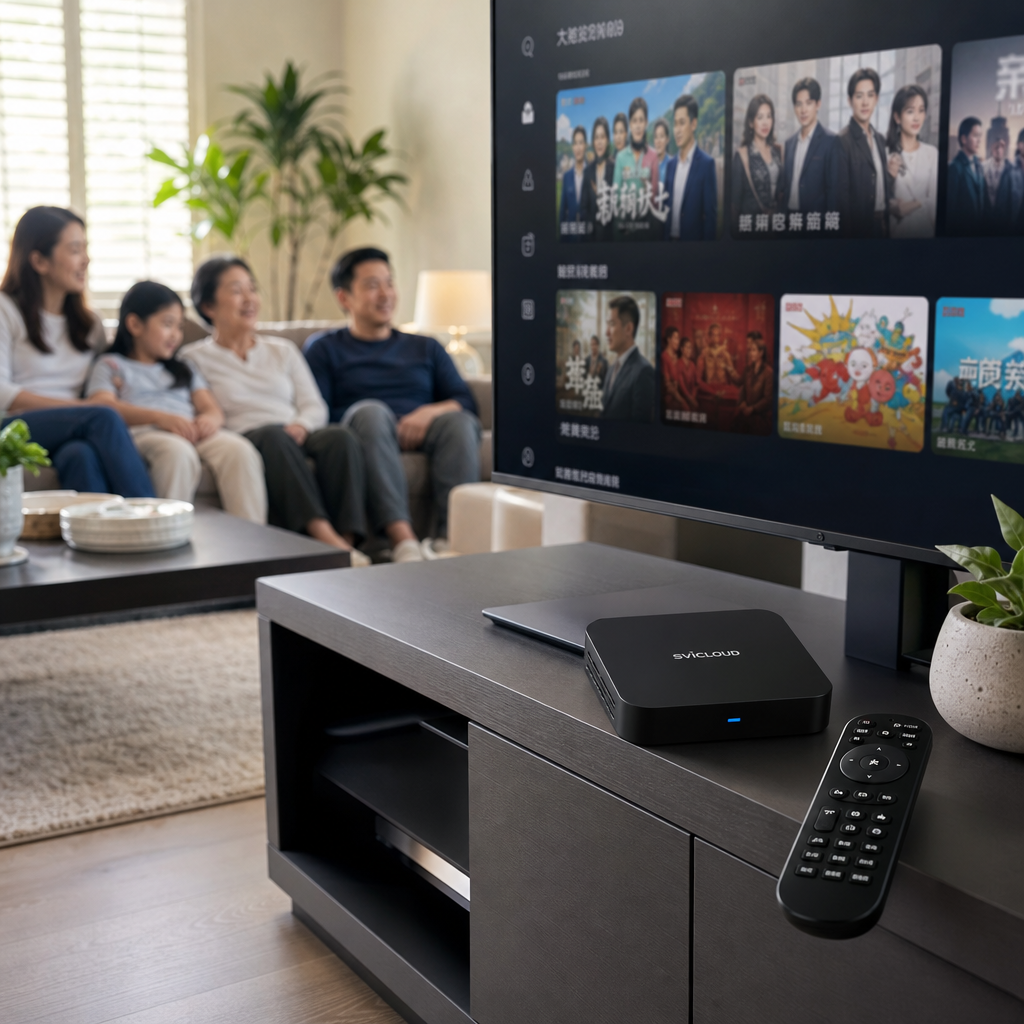
For Chinese families living in the United States, the living room is often more than just a place to watch TV. It is a shared space where the whole family relaxes, chats, watches dramas, catches the news, and grows together with the children. To make it easy for parents, elders, and children to use, a suitable Chinese audio-visual setup is not just about the devices themselves, but about whether the overall plan fits everyday life.
Why do Chinese American families especially need a practical Chinese audio-visual setup?
The needs of a family watching programs are actually very different
Many families initially think, “As long as it works, that’s enough.” But once they start using it every day, they realize that everyone’s needs are quite different. Parents may want to quickly turn on the TV after work and then watch Chinese news, dramas, or talk shows. Elders usually care more about whether the text is large enough, whether the menu is clear, and whether switching is too complicated.
Children’s usage scenarios are different too. For children, whether cartoons, animation, and family-friendly content are easy to find, and whether the operation is safe and won’t lead to accidentally changing too many settings, often matters more than having lots of features. As for when the whole family uses it together, whether you can quickly switch to variety shows, movies, or programs that everyone is willing to watch will directly affect how often the living room gets used.
The living room is the family entertainment center, not just a place for a TV
A good Chinese audio-visual setup for the living room usually includes several key aspects, not just whether the screen is large. For example:
- Whether the TV size suits the living room space
- Whether the picture quality is clear enough for multiple people to watch together
- Whether the network is stable enough to avoid buffering during peak evening hours
- Whether the remote control and interface are easy to use
- Whether Chinese content is organized clearly and easy to search
For Chinese American families in the U.S., there is also a very practical consideration: if the device needs setup, updates, or after-sales assistance, can you get local U.S. customer support that is easy to communicate with? This is especially important when there are elders at home or when you want to reduce the time spent troubleshooting on your own.
What you will learn in this article
This article will start from real family usage scenarios and walk you step by step through how to organize a suitable living room Chinese audio-visual plan, including:
- How to assess your family’s audio-visual needs
- How to match the TV, network, sound, and devices
- How to balance dramas, news, variety shows, children, and elder use
- Which details are most worth prioritizing when choosing devices
- Why local customer service and after-sales support can make family use more reassuring
If you want to compare devices first, you can also refer to SVICLOUD Plan Comparison. If you want to learn about the brand and stock information, visit the SVICLOUD U.S. Official Website.
Start with family usage scenarios and identify your household’s audio-visual needs
Scenario 1: Relaxing with dramas on weekday evenings
For many families, the most common time to use the TV is after dinner on weekdays. After a busy day, people come home and want to turn it on quickly and get into what they want to watch without spending too much time searching for programs, waiting for loading, or dealing with settings.
In this scenario, the main priorities are usually:
- Simple startup process
- Easy access to frequently watched content
- Smooth switching without slowing down the relaxation flow
- Stable picture quality, suitable for long viewing sessions
If your family regularly follows Chinese drama series, whether favorites, categories, and search functions are clear will also significantly affect the user experience.
Scenario 2: Watching news and talk shows on weekends
On weekends or at fixed morning and evening times, some families make watching Chinese news part of their daily routine. Especially for Chinese families in California, New York, Texas, and other places, besides keeping up with local U.S. information, they often also want to stay connected to familiar Chinese current affairs content and program rhythms.
The core of this need is not flashy features, but efficient access to information. An ideal living room audio-visual device should make news, finance, current affairs, commentary, and similar content easy to organize and easy to find, without having to jump around repeatedly.
Scenario 3: Watching variety shows and movies together as a family
The most family-oriented moments in the living room are often when everyone sits down together to watch variety shows, movies, or major programs. At this time, screen size, sound clarity, and the overall atmosphere become more important than when watching alone.
If your family watches together often, it is recommended to include the following points in your planning:
- The screen size should allow everyone to see clearly
- The sound should have enough vocal clarity
- Remote switching should be intuitive to avoid interrupting the mood
- Content entry points should be clear to reduce search time
Scenario 4: Sharing the device between children and elders
This is one of the most common and easiest-to-overlook issues in many Chinese families. If a device is only used by younger adults, a more complicated setup may still be manageable. But once children and elders both need to use it comfortably, the design must be closer to everyday life.
Children need:
- Content that is easy to distinguish
- Usage habits that can be guided
- Protection from accidentally touching too many complicated settings
Elders need:
- Clear Chinese interface
- Large text and simple menus
- Frequently watched content placed prominently
- Intuitive remote buttons, without too many steps to remember
If a device can take both ends into account at once, the living room experience is usually much more stable.
The core of a Chinese living room audio-visual setup: start with these 4 things
1. The TV itself: picture quality and size must be matched first
The TV is the center of the living room, but bigger is not always better; it needs to fit the space. If the living room is small, a screen that is too large may cause visual fatigue. If the space is open or multiple people often watch together, a screen that is too small can affect viewing comfort.
In terms of picture quality, the difference between 1080p and 4K is especially noticeable on large screens and at closer viewing distances. If your family often watches dramas, movies, or variety shows together, a larger screen combined with clearer image quality usually provides a better overall experience.
A simple guideline is to look at:
- The viewing distance in the living room
- How many people usually watch at the same time
- Whether high-quality content is often watched
- Whether subtitle clarity matters a lot
2. Network: stability is more important than speed
Many people only look at the speed number when planning audio-visual setup, but in real use, stability is often the key factor. Especially when there are many family members, phones, tablets, laptops, game consoles, and smart home devices all using the internet at the same time, streaming quality is easily affected during evening peak hours.
If buffering, sudden changes in picture quality, or inconsistent playback happen while watching dramas, the problem is not always the device itself. It may also be due to:
- The router being too far from the living room
- Too many walls in between
- An overcrowded Wi‑Fi band
- Too many devices connected at the same time
If conditions allow, using a more stable connection for the living room device can usually reduce stuttering effectively.
3. Audio-visual devices: make Chinese content easier to find and enjoy
For Chinese families, the value of an audio-visual device is not just that it can play content, but whether it can organize Chinese content in a way that is easier to understand and use. A good interface should make news, dramas, variety shows, and children’s content clearly categorized so that family members spend less time searching and more time watching.
When choosing a device, pay attention to:
- Whether the Chinese interface is intuitive
- Whether search and categories are clear
- Whether frequently watched content can be accessed quickly
- Whether elders can easily learn the basic operation
If you are comparing different options, you can first look at SVICLOUD Plan Comparison to understand the differences between SVICLOUD 10P+ and SVICLOUD 10S.
4. Sound: you cannot ignore audio in the living room experience
Many families spend their budget on the picture and underestimate the importance of sound. In fact, whether you are watching news, dramas, or variety shows, clear dialogue directly affects comfort, especially when there are elders at home.
If you rely only on the built-in TV speakers, sometimes the background sound may be too loud and the dialogue may not stand out enough. If the family often watches movies, music programs, or variety shows together, external speakers or a soundbar can often create a more complete living room atmosphere.
You can decide according to your habits:
- Mainly news: prioritize clear dialogue
- Mainly dramas: focus on balancing dialogue and music
- Often watch variety shows and movies: consider sound with more spaciousness
If you want to understand device setup and common questions first, you can also refer to SVICLOUD FAQ.
How to plan a practical living room audio-visual setup for Chinese American families
Plan 1: Simple entry-level setup
If you are building a Chinese audio-visual environment for the first time, or if the household has only a few members, an entry-level setup is usually the most practical. The core goal is not to pile on features, but to make the devices easy to use and quick to get started, so the content you watch often is concentrated in one living room setup.
This type of setup is suitable for:
- Small families
- Families newly moved to the U.S.
- People who want to establish a stable Chinese viewing habit first
- Families that want elders to be able to learn the operation quickly when they visit
Recommended direction:
- A TV with a suitable size
- Stable home internet
- A 小雲電視盒 with a clear Chinese interface
- Simple, easy-to-learn remote control operation
Plan 2: Family-sharing setup
If the household includes parents, children, and elders using it together, balance matters more than any single standout feature. The focus of this type of setup is diverse content, clear categories, and easy switching, so people of different ages can all find their own way of using it.
A family-sharing setup is especially suitable for:
- Families that take turns using the living room on weekday evenings
- Families that often watch programs together on weekends
- Households with elders living together or frequent long-term guests
- Families that want children’s and adults’ content to stay organized separately
When planning, focus on:
- A simple homepage without too many entry points
- Frequently watched programs placed first
- Fixed habits for elders’ commonly used content
- Clear content separation when children use it
Plan 3: High-quality home theater setup
Some families treat the living room as the main entertainment space and place special emphasis on picture quality, sound, and immersion. This type of setup is suitable for people who often watch movies, dramas, or concert-type content, or who want a more complete viewing experience at home.
This kind of setup usually cares more about:
- The combination of a large screen and high picture quality
- Router and network stability
- The overall performance of the sound system
- Smooth operation and everyday reliability
However, even in a high-quality setup, it is still important to remember this: for a family-shared device, the final question always comes back to whether it is easy to use. Great picture quality but an interface that elders cannot operate, or content that is too scattered to find, will still reduce actual usage.
How different family members affect the setup
The table below can help you quickly organize your household priorities:
| Family member | Main concern | Setup suggestion |
|---|---|---|
| Parents | Dramas, news, and program accessibility | Keep frequently watched content centralized and switching smooth |
| Elders | Large text, fewer steps, clear menus | Intuitive Chinese interface, simple remote |
| Children | Age-appropriate content, easy operation | Establish fixed usage areas and viewing habits |
| Whole family | Convenient shared watching of variety shows and movies | Large screen, clear sound, quick switching |
How should Chinese content be arranged so the whole family wants to use it?
News and current affairs: keep the family connected
For many Chinese families, watching Chinese news is not just about getting information, but also a way to stay connected to language, culture, and the rhythm of daily life. Especially for elders and parents, there is often a fixed habit of watching news at certain times.
It is best to keep the arrangement as simple as possible:
- Put frequently watched news entry points where they are easy to find
- Do not make the homepage too cluttered, to avoid multiple layers of clicks
- Keep the viewing path consistent so family members can remember it easily
The benefit of this is that elders and parents can get comfortable faster, and it also reduces the need for family members to help open it every time.
Dramas and variety shows: the main source of family entertainment
In most families, dramas and variety shows are still the most frequently used content in the living room. Dramas are suitable for individuals or couples to relax on weekday evenings, while variety shows are suitable for the whole family to watch together and create shared topics and interaction.
If your family has a regular drama-watching habit, it is recommended to pay special attention to:
- How easy the search function is to use
- Whether favorites and continue-watching are easy to find
- Whether episode switching is convenient
- Whether subtitles and picture quality are clear and stable
When the device handles these basic experiences well, family daily use naturally becomes much more stable.
Children’s content: balancing entertainment and peace of mind
When children use the living room device, parents usually care most about two things: whether the content is appropriate and whether the operation is too complicated. Rather than letting children search randomly through many unfamiliar entry points, it is better to establish a simple, fixed usage habit from the beginning.
Possible approaches include:
- Setting a fixed viewing time for children
- Choosing content areas that are easy to identify
- Avoiding too many adult content entry points on the same level
- Having parents demonstrate the basic operating steps first
This can balance parent-child companionship and daily management, and it also makes household usage conflicts less likely.
Elders’ content: simple, familiar, and understandable
When elders use the device, the most important thing is usually not features, but familiarity. If frequently watched content can be placed at the front, text is clear, and steps are consistent, they are more likely to learn to use it on their own.
A few especially practical tips:
- Put the content elders watch most often in a prominent position on the homepage
- Try to keep the operating sequence fixed
- If possible, briefly explain the commonly used remote buttons
- In the beginning, walk them through it a few times to build confidence
For a family, once elders can use the device independently, the convenience of the entire living room improves significantly.
Key device selection points|What kind of set-top box is more suitable for shared living room use?
Is the interface easy to learn?
The biggest fear for shared living room devices is not too few features, but too many features that are hard to find. Whether the Chinese interface is clear and whether the menu structure is intuitive directly affects whether family members are willing to use it every day.
When choosing, you can ask yourself a few questions:
- After opening it, can you quickly know where to go next?
- Do elders need reminders from others to find a program?
- Can frequently watched content be accessed in just a few steps?
If the answers are mostly positive, the device is usually more suitable for family sharing.
Is the operation smooth?
The living room is a high-frequency use space, so smooth performance matters. Slow startup, slow switching, and search lag all reduce willingness to use the device over time, and may even push family members back to watching separately on phones or tablets.
Practical checks include:
- Whether you can enter content quickly after startup
- Whether remote commands respond smoothly
- Whether program switching is stable
- Whether it remains stable after long periods of use
If you are considering different models, it is best to compare them based on real family usage needs rather than only looking at specification names. Related differences can be found in SVICLOUD Plan Comparison.
Is the content classification complete?
For Chinese American families, clear content classification is often more noticeable than simply having a large amount of content. Because each family member has different goals, the real daily issue is whether news, dramas, variety shows, and children’s content can be found quickly.
The ideal situation usually looks like this:
- News and current affairs are clearly organized
- Dramas and variety shows are easy to identify
- Children’s content is not mixed with adult content
- Different family members can build their own viewing habits
Is after-sales support convenient?
For family users, the device is not the end of the story once you buy it. Installation, setup, updates, troubleshooting, and ongoing support are all part of the overall experience. Especially in the U.S., if you can use local customer service and communicate in Chinese, it usually saves time and feels more reassuring.
You can pay special attention to:
- Whether the contact methods are clear
- Whether help can be found when problems occur
- Whether the after-sales process is easy to understand
- Whether there is a FAQ section for self-checking first
If you want to learn about support options first, check U.S. Customer Service and After-Sales Support. If you want to understand setup and usage questions first, you can also read SVICLOUD FAQ.
How should the living room network be set up to avoid buffering while watching dramas?
First understand how many people are online at the same time at home
Many people think upgrading speed alone will solve the problem, but in reality, during evening home internet peak times, what often affects streaming the most is the number of devices and how the network is distributed. Phones, tablets, laptops, game consoles, doorbell cameras, and smart speakers may all continue using network resources.
It helps to take inventory of these questions:
- How many people are online at the same time in the evening?
- Is someone joining a video meeting or playing games?
- Is the living room far from the router?
- Does the streaming lag happen only at fixed times?
If the problem is concentrated in the evening, it usually means the household peak traffic is indeed affecting living room viewing.
Router placement is crucial
If the router is placed in a corner of the house, inside a cabinet, or blocked by large furniture, the living room device may still have poor signal even if the plan itself is not bad. For common apartments, townhomes, or single-story homes in California, New York, and Texas, router placement has a major effect.
In practice, it is recommended to:
- Place it as close to the living room or the center of the home as possible
- Avoid putting it in metal cabinets or enclosed spaces
- Minimize thick wall barriers between the router and devices
- If the house is larger, consider improving overall coverage
Prioritize stability, not just numbers on paper
If your main goal is stable drama watching and news viewing, instead of constantly chasing higher speed numbers, it is better to first confirm real-world stability. As long as latency is low, fluctuations are small, and the signal is steady, it usually improves the family viewing experience more than headline speed numbers.
A simple order of priority can be:
1. Confirm the router position first 2. Check whether the living room signal is stable 3. Reduce unnecessary traffic during peak hours 4. Adjust household connection methods as needed
The living room device and network should be considered together
Many families think about the TV, the box, and the network separately, but in reality these three are linked. Even if the device is good, a weak living room connection will still lead to buffering and waiting. Conversely, even if the network is fine, a complicated interface will still make the family not want to use it.
Therefore, when planning, it is recommended to evaluate these four points together:
- TV size and picture quality
- Home network stability
- Chinese audio-visual device user experience
- Whether family members can use it easily
Practical considerations for families in California, New York, and Texas
California families: varied home layouts, with a focus on family sharing
Chinese families in California live in many different types of homes: apartments, townhouses, or detached houses. For many families, the living room is not only for watching TV, but may also be a space where children play, the family chats, and guests are received.
Therefore, the setup is especially well-suited to emphasizing:
- Simple operation in a multipurpose living room
- Quick switching to content that everyone wants to watch
- Stable router placement and overall coverage
- Content arrangements that balance variety shows, movies, and news
New York families: limited space means efficiency matters more
Many New York families have relatively limited living space, so the living room setup needs to focus on “not taking up too much mental energy.” You do not necessarily need many devices, but the operating flow should be clear and intuitive to reduce repeated setup and moving around.
New York families can prioritize:
- Precise matching of screen size and viewing distance
- Simple interface and concentrated content
- Clear sound so the volume does not need to be turned up too high
- The ability to balance shared viewing needs even in a small space
Texas families: larger spaces mean more attention to network and sound
Some Texas families have larger living rooms, and if the home is more spacious, the audio-visual experience often depends more on a complete setup. In that case, not only does the screen need to be sufficient, but the network and sound also show greater differences.
When planning for Texas families, pay attention to:
- Larger living rooms need clearer picture quality
- Router placement has a greater impact on whole-home signal coverage
- If sound is too dispersed, elders will find it harder to hear clearly
- When everyone watches together, switching efficiency and stability matter more
The role of 小雲電視盒 in a family living room setup
Suitable for shared family use, with a focus on everyday convenience
For most Chinese families, the reason a 小雲電視盒 is worth including in the living room plan is not just because it is an audio-visual device, but because it can integrate Chinese content, operation flow, and family usage habits more smoothly.
What really matters are these points:
- Family members can understand it after opening it
- Frequently watched content is easy to find
- Elders will not give up because the steps are too many
- Children’s and adults’ content usage can be more organized
If you are comparing SVICLOUD 10P+ and SVICLOUD 10S, it is recommended to directly check the official SVICLOUD Plan Comparison, which is more efficient than piecing together information on your own.
It is not about having more features, but about fitting your family
Some families focus on dramas, some need to watch news every day, and others care more about whether children and elders can use it together. When choosing a device, rather than chasing the “strongest,” first confirm:
- What your family watches most often
- Who uses the living room device most often
- Whether the whole family needs to learn it quickly
- Whether you value U.S. local customer service and after-sales assistance
Choosing this way usually makes it easier to find a solution that is truly durable and suitable for daily life.
What really matters when building a living room Chinese audio-visual setup that the whole family will use?
The key is not piling on devices, but reducing friction
A good living room audio-visual setup is actually very simple at its core: let family members spend less time dealing with devices and more time enjoying the content. When startup is smooth, content is easy to find, the picture is stable, and the sound is clear, the living room naturally becomes a place where the family gathers again.
You can condense the planning focus into four sentences:
- The TV size should be suitable
- Network stability matters more than speed
- Device operation should take elders and children into account
- Clear after-sales support makes things more reassuring later
Start by adjusting the scenarios that happen most often
If you do not want to change too many devices at once, that is fine. The most practical approach is to start with the scenarios that happen most often in your home. For example:
- If the whole family watches dramas most often: first optimize the TV and network
- If elders watch news most often: first organize the interface and common entry points
- If children use it often: first establish a fixed usage method
- If setup problems happen often: first confirm the customer service and support process
Adjusting step by step will improve life more effectively than buying many devices at once that are not easy to use.
What to do next?
If you are planning a Chinese audio-visual setup for a U.S. Chinese family living room, it is recommended to start by looking at your needs and support information, then compare options further.
You can refer to the following in order:
- SVICLOUD U.S. Official Website: View U.S. region information and official content
- SVICLOUD Plan Comparison: Compare SVICLOUD 10P+ and SVICLOUD 10S
- U.S. Customer Service and After-Sales Support: Arrange Chinese-language assistance and learn about installation and follow-up support
- SVICLOUD FAQ: Learn about setup, payment, and after-sales details first
If your goal is to make sure parents, children, and elders can all comfortably watch Chinese content in the same living room, then planning from the perspective of “family scenarios” is usually the most reliable and practical first step.