
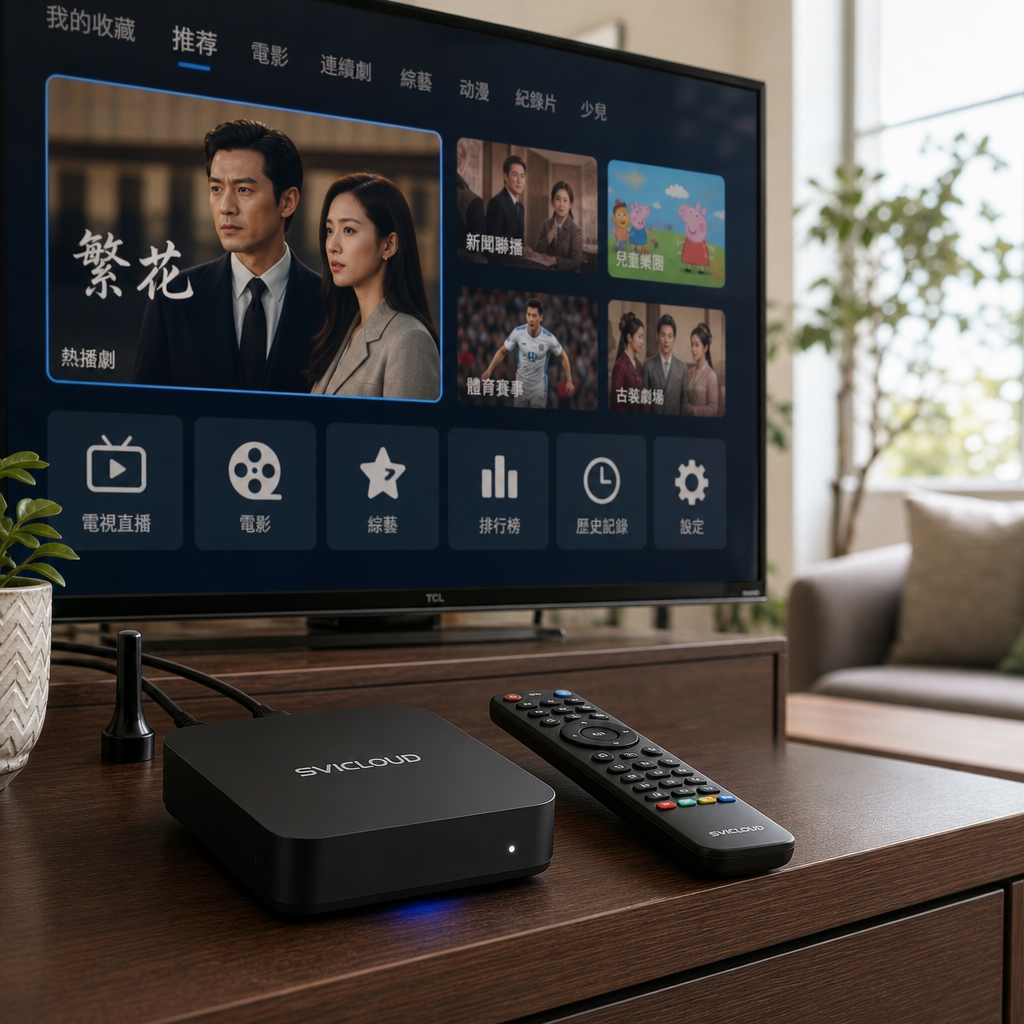
A Buying Guide for Chinese TV Boxes for Chinese Americans in the U.S.: Understand the Interface, Customer Service, Warranty, and Home Entertainment Experience at Once
> SEO Title: A Buying Guide for Chinese TV Boxes in the U.S. | Chinese Interface, Customer Service, Warranty, and Key Points for Home Use > Meta Description: Want to watch Chinese TV, Chinese-language video, and family entertainment in the U.S.? This guide organizes the key points for choosing a Chinese TV box, including Chinese interface, network stability, U.S.-based local customer service, warranty service, and home-use scenarios, helping Chinese Americans choose a TV Box that better suits their household. > URL Slug: `/blog/chinese-tv-box-buying-guide-us`
Chinese families living in the United States often face a very practical question: they want to watch Chinese-language content, Chinese videos, news, dramas, variety shows, or family entertainment on the big screen in the living room, but watching on a phone, tablet, or computer for a long time is uncomfortable; casting a phone to the TV can also easily lag, disconnect, and be interrupted by message notifications.
This is why a “Chinese TV box” has become a living-room device many Chinese American households consider. For seniors, a Chinese interface and remote-control operation are more intuitive than English apps; for parents, stable video playback and clear categories are more worry-free; for children, a large screen is also more suitable for the family to watch educational content, children’s programs, or legal video apps together.
However, choosing a Chinese TV box should not be based only on the “spec sheet” or “how much content it has.” For users in the United States, what matters more is whether the Chinese interface is easy to use, whether the internet connection is stable, whether it suits the TV at home, whether Chinese-language customer service is available when problems occur, and whether the warranty and after-sales process is clear.
This “Buying Guide for Chinese TV Boxes for Chinese Americans in the U.S.” will help you evaluate more clearly which type of TV Box is more suitable for your home from the perspectives of household needs, Chinese interface, U.S.-based local customer service, warranty service, network stability, video experience, and a practical buying checklist.
---
Why do Chinese American households need a Chinese TV box?
Meeting different video needs for seniors, parents, and children
The video needs of Chinese American households are usually not limited to just one type. Many families have three generations living together, or parents are preparing TV equipment for seniors; there are also young couples who hope to watch Chinese-language content, movies, YouTube, or other legal streaming apps more conveniently after work.
For seniors, the most important thing is usually not the highest specifications, but “being able to understand it, find it, and know how to press it.” If the TV box interface is in Chinese, the homepage categories are clear, and remote-control operation is not complicated, the barrier to use can be greatly reduced. When seniors want to watch Chinese-language news, variety shows, dramas, classic programs, or familiar video content, they do not need to ask family members to help them find it every time.
For parents or young families, the needs may lean more toward picture quality, smooth operation, app compatibility, and the overall audiovisual experience. If a TV box can bring commonly used video services together on the TV, the living room becomes more like a family entertainment center, instead of everyone staring at their own phone.
For children, a large screen can be used to watch educational videos, children’s programs, or content selected together by the family. Compared with letting children hold a small screen for long periods of time, a TV box paired with a living-room TV also makes it easier for parents to participate and manage viewing time.
The core value of a Chinese TV box is not only “being able to watch Chinese content,” but bringing the video needs of different generations together on the living-room TV, making it easier for family members to use it together.
---
More suitable than phone casting for long family viewing sessions
Before buying a TV box, many people first use phone casting, AirPlay, Cast, or similar methods to send videos to the TV. This method is very convenient for short-term use, but if the family watches for a long time, some common problems appear:
- When a phone receives a notification, the picture or sound may be interrupted.
- The phone battery drops and needs to be charged while in use.
- Casting quality is easily affected by Wi-Fi, phone performance, and app support.
- Seniors may not be familiar with the casting steps and need family members to help every time.
- If the phone owner leaves the living room, playback may stop or become inconvenient to control.
By comparison, a TV box is usually fixed to the TV. After turning on the TV and the TV box, it can be operated directly. For the living room, bedroom, seniors’ room, or family gathering scenarios, this type of fixed device better matches everyday usage habits.
Especially in the United States, home TVs are generally larger, and the living room is also the main space where family members gather. If you want Chinese-language video content to become part of family entertainment instead of relying only on temporary casting from one phone, choosing a suitable Chinese TV box will be more practical.
---
U.S. usage scenarios are different from Asian usage scenarios
Many people directly apply buying experiences from Asian markets to the United States, but in fact there are many differences in the home-use environment in the U.S.
For example, U.S. homes are often larger, and the router may be placed in the living room, study, or basement, not necessarily close to the TV. Housing types also differ in California, New York, and Texas: many California homes use open living rooms; New York apartments are more compact but may have more Wi-Fi interference; single-family homes in Texas are larger, and rooms may be farther from the router. All of these factors affect the network stability of a TV box.
In addition, U.S. users also need to consider:
- Whether the purchasing channel is clear.
- Whether after-sales support applicable to the U.S. region is available.
- Whether the warranty process is easy to understand.
- Whether customer service can communicate in Chinese.
- When network setup, system updates, or operation problems occur, whether someone can help troubleshoot.
For Chinese American households, “being able to buy it” is only the first step; what truly matters is “using it stably, watching smoothly, and having someone help when problems occur.”
If you want to first learn about SVICLOUD TV Box US products and official information, you can visit the SVICLOUD U.S. official website; if you want to compare different options, you can also refer to SVICLOUD Plan Comparison.
---
Before choosing a Chinese TV box, first confirm your household usage needs
Who is the main user at home?
Before choosing a TV box, the first question is not “which one has the highest specifications,” but “who uses it most often.”
If the main users are seniors, the buying priorities should be:
- Whether the Chinese interface is clear.
- Whether the remote control is easy to understand.
- Whether the font and menus are easy to recognize.
- Whether complicated setup is required.
- Whether Chinese customer service assistance is available when problems occur.
- Whether there are clear after-sales and warranty explanations.
Seniors usually do not study new functions every day. What they need is stability, intuitiveness, and fewer errors. Features that are too complicated may instead increase usage pressure.
If the main users are couples, young working adults, or young families, the focus may lean more toward:
- Whether operation is smooth.
- Whether picture and audio output match the TV equipment.
- Whether commonly used video apps can be used smoothly.
- Whether system categories are clear.
- Whether it is suitable for quickly opening and watching after work.
If the whole family shares it, then the needs of seniors and younger users must be balanced. In this case, Chinese interface, stability, app compatibility, hardware performance, and after-sales support all need to be considered together, rather than focusing on only one item.
---
Main types of content watched
Different families have different expectations for a “Chinese TV box.” Some people mainly watch Chinese dramas, some watch news, some value variety shows or movies, and others simply want to bring YouTube, legal streaming apps, and family videos together on the TV.
When choosing, you can first list the types of content most commonly watched at home:
- Chinese-language dramas and TV series.
- Variety shows.
- News and current affairs.
- Movies.
- Children’s and educational content.
- YouTube.
- Legal streaming apps.
- Family photos, videos, or local media playback.
Here is a special reminder: do not only look at vague claims such as “how much content there is.” For long-term use, what truly affects the experience is:
- Whether content categories are easy to find.
- Whether search is convenient.
- Whether the picture is stable.
- Whether apps can be updated normally.
- Whether the operation is not easy to get lost in.
- Whether it can work with your home network environment.
Legal content sources, app terms, and regional restrictions should also be respected. The availability, content licensing, and account rules of different video platforms in the United States may differ. Before use, it is recommended to refer to each platform’s official instructions.
---
Usage space and TV equipment
A TV box is living-room equipment, but it does not necessarily have to be placed only in the living room. Different spaces have different buying priorities.
Large living-room TV If your home uses a large-size TV, picture quality, resolution support, connection stability, and remote-control convenience become more important. A large screen magnifies picture-quality differences and makes it easier to notice whether playback is smooth. If the family often watches movies or programs together on weekends, the stability of the living-room equipment is especially important.
Bedroom TV Bedroom use usually emphasizes simplicity, quietness, and low interference. Device size, cable organization, startup process, and remote-control operation all affect the daily experience. Many people watch one episode of a drama or the news before bed and do not want the setup process to be too complicated.
Seniors’ room For a seniors’ room, the most important thing is reducing operation difficulty. A Chinese menu, clear categories, simple remote control, and customer service assistance are more important than advanced functions. If you are buying it for your parents, it is recommended to first confirm whether they are familiar with the current TV input switching, Wi-Fi name and password, and whether they need you to assist remotely or by phone.
If you want to compare different product positioning, you can first refer to SVICLOUD Plan Comparison; if this is your first installation or you have setup questions, you can also view SVICLOUD FAQ.
---
A Chinese interface is the first key factor for Chinese Americans choosing a TV Box
Full Chinese operation can lower the learning cost
For many Chinese American households, a Chinese interface is not a bonus feature, but a basic requirement. Especially when buying for parents or seniors, if the homepage, categories, search, and settings are all in English, even if the device has many functions, actual use may still be full of difficulties.
A Chinese TV box suitable for Chinese households should have several interface features:
- The homepage logic is clear and does not require constantly switching through complicated menus.
- Content categories are easy to understand.
- Settings are not hidden too deeply.
- On-screen prompts are clear.
- Remote-control buttons and on-screen operations correspond intuitively.
- Font size and contrast are suitable for TV viewing.
Many young people feel that “an English interface is fine,” but for seniors who are not familiar with English operation, every English menu may become an obstacle. Only when the operation barrier is lowered will seniors be more willing to use it by themselves, instead of waiting for their children to come home and help every time.
---
Traditional Chinese and Simplified Chinese display needs
The Chinese American community is very diverse, with families from Taiwan, Hong Kong, Mainland China, Southeast Asia, and other regions. Different families also have different preferences for Chinese display. Some seniors are used to Traditional Chinese, while some users prefer Simplified Chinese.
When choosing a TV box with a Chinese interface, you can pay attention to:
- Whether the system language can be adjusted.
- Whether the menu supports Traditional Chinese or Simplified Chinese.
- Whether content titles and categories are easy to recognize.
- Whether the font is clear, without garbled text or incomplete display.
- Whether the main users at home can understand the default interface.
If the seniors at home are used to Traditional Chinese, it is recommended to check the official product page, instruction page, or customer service information before purchase to confirm whether the interface and operation match their usage habits. Interface language may seem like a small detail, but it directly affects the comfort of everyday use.
---
Is search and input convenient?
Many people only discover after buying a TV box that the real trouble is not playback, but “finding content.” If Chinese search is not easy to use, or if every search requires entering characters one by one with a remote control, seniors will quickly give up.
When choosing, you can pay attention to the following points:
- Whether there is clear category browsing.
- Whether convenient Chinese search methods are supported.
- Whether pinyin, zhuyin, voice, or other simplified input methods can be used depends on the device’s actual support.
- Whether search results are easy to understand.
- Whether frequently watched content can be placed somewhere easy to find.
For seniors, the fewer input steps, the better. Ideally, they can quickly find frequently watched content through categories, history, favorites, or homepage recommendations, instead of searching from scratch every time.
---
U.S.-based local customer service and warranty service: buying a TV box is not only about specifications
Why is U.S.-based local customer service important?
When using a Chinese TV box in the United States, common problems are not necessarily hardware failures. Instead, they may be:
- Not knowing how to connect cables during the first installation.
- Entering the Wi-Fi password incorrectly.
- The router being too far away, causing unstable playback.
- Unclear TV HDMI input switching.
- Not being familiar with the new screen after a system update.
- Needing assistance with app login or settings.
- Seniors describing problems incompletely, making it hard for family members to judge remotely.
If these problems can be communicated in Chinese, they are much easier to handle. Especially when children buy the device for their parents, Chinese customer service can reduce the cost of explaining back and forth and can also provide suggestions that better fit U.S. household network environments.
The value of “U.S.-based local customer service” is not only language convenience, but also greater familiarity with common U.S. internet services, home spaces, TV equipment, and usage habits. Whether you are using it in California, New York, Texas, or another state, having a clear official support channel when setup and after-sales issues arise provides more peace of mind.
If you need to learn about customer service and after-sales support methods, you can view U.S. Customer Service and After-Sales Support.
---
What warranty-service details should you look at?
For warranty, it is not enough to see whether it exists; you also need to see whether the explanation is clear and the process is explicit. Before buying a TV box, it is recommended to confirm the following details:
- What situations are included in the warranty scope.
- What situations may not be covered by the warranty.
- Whether an order number, proof of purchase, or product serial number is required.
- Whether the warranty application method is an online form, customer-service contact, or another process.
- If inspection or return shipping is needed, how the process is carried out.
- Whether the warranty and after-sales explanations are provided by the official source or an authorized channel.
- Whether the latest policy can be checked on the official website.
Because after-sales conditions may differ depending on the purchase channel, it is recommended to prioritize buying from the official website or reliable channels, and to keep order information, payment records, and necessary information from the product packaging. If you need to inquire about service later, these materials will be very important.
Please note that warranty details may vary depending on official policy, product condition, or purchase channel. Before purchase, the SVICLOUD TV Box US official page or customer service response should prevail. You can also first read SVICLOUD FAQ to learn about setup, payment, and warranty-related explanations.
---
After-sales support is more important than a one-time low price
A TV box is a home audiovisual device for long-term use, not a product bought to be used only once or twice. Many households place one device in the living room, bedroom, or seniors’ room and use it weekly or even daily. Therefore, the value of after-sales support is often more important than a one-time low price.
Low-priced products may look attractive, but if the following situations occur, the later costs may be higher:
- Customer service cannot be found.
- The operation interface is unclear.
- System updates have no explanation.
- When problems occur, you do not know who to report them to.
- The purchase source is unclear, making the warranty hard to confirm.
- Seniors do not know how to use it, and the device ends up idle.
By contrast, if product information is clear, official support is complete, and customer-service communication is convenient, then even if it takes more time to compare at the beginning, there is a better chance of gaining a stable long-term experience.
For Chinese American households, buying a Chinese TV box is not only buying hardware, but buying a “home audiovisual solution”: including the device, interface, setup, customer service, warranty, and future usage support.
---
Network stability: a key factor affecting the viewing experience
Wi-Fi signal is more important than you think
Many people think that unsmooth TV-box playback means the device has a problem, but in U.S. homes, the network environment is often a more common influencing factor. Especially in large houses, upstairs and downstairs layouts, basements, converted garage rooms, or homes where the router is placed far away, the Wi-Fi signal may already be weaker by the time it reaches the TV location.
Factors that affect Wi-Fi stability include:
- The router is too far from the TV box.
- Walls, floors, or metal furniture block the signal in between.
- There is heavy Wi-Fi interference from nearby residents, especially in apartments or multi-unit housing.
- Multiple people at home are watching videos, playing games, or having video meetings at the same time.
- The router itself is older and lacks performance.
- The TV box is placed behind the TV, causing the signal to be obstructed.
If you live in a New York apartment, you may need to pay attention to Wi-Fi interference; if you live in a larger single-family home in Texas, you may need to consider router placement or Mesh Wi-Fi; if you live in an open-layout home in California, the living-room signal is usually better, but you still need to pay attention to bandwidth allocation when multiple devices are used at the same time.
---
Choosing between wired internet and Wi-Fi
If the TV box and router are very close, wired internet is usually more stable. For high-quality video, long playback sessions, or family gathering viewing, a wired connection can reduce buffering or interruptions caused by Wi-Fi fluctuations.
However, not every household can conveniently run an Ethernet cable. If using Wi-Fi, it is recommended to:
- Keep the TV box as close to the router as possible.
- Avoid completely hiding the TV box inside a metal cabinet or behind the TV.
- If the home space is large, consider Mesh Wi-Fi or a Wi-Fi extender.
- Reduce large downloads or uploads happening at the same time.
- Restart the router regularly to maintain network condition.
- Confirm that your home internet plan is sufficient to support multiple people streaming at the same time.
When choosing a TV box, you can also check whether the product information explains network connection methods and setup steps. If you are unsure whether your home network environment is suitable, you can ask customer service for advice first.
---
Streaming stability depends not only on the box, but also on the overall environment
Whether video playback is smooth is usually determined by multiple factors together:
- TV box hardware performance.
- Network speed and stability.
- Router quality.
- Video platform server status.
- App version and system updates.
- Number of devices using the network at home at the same time.
- Video resolution settings.
Therefore, when choosing, do not only ask “will it lag?” Instead, evaluate from the overall environment. If your home already often has unstable Wi-Fi on phones and computers, you should improve the network environment before replacing the TV box. Conversely, if your home network is stable, choosing a device with smooth operation, good support, and clear after-sales service will usually make it easier to achieve a stable experience.
---
Audiovisual experience: picture quality, sound, and operating smoothness all need to be considered together
Picture quality is not only a resolution number
When choosing a TV box, many people first look at resolution support, but the actual viewing experience is not determined only by resolution. Even if the device supports high resolution, the video source, network speed, the TV’s own specifications, and HDMI connection quality all affect the final picture.
Before buying, you can confirm:
- The resolution supported by your home TV.
- Whether the TV box output settings are easy to adjust.
- Whether the HDMI connection is stable.
- Whether commonly used apps or video sources provide the corresponding picture quality.
- Whether your home network can support high-quality streaming.
- Whether aspect ratio, subtitle display, and color match your habits.
If the device is mainly for seniors to watch news, dramas, or variety shows, stability and clarity may be more important than pursuing the highest specifications. If you often watch movies or big-screen video, then you can place more importance on picture output and playback stability.
---
Sound experience is also very important
Many families only look at the picture when choosing a TV box and overlook sound. In fact, for seniors or family movie watching, sound clarity is very important. News, spoken dialogue, drama lines, and variety shows all need clear sound performance.
You can pay attention to:
- Whether the TV’s built-in speakers are sufficient.
- Whether an external soundbar or speaker system is needed.
- Whether HDMI audio output works normally.
- Whether subtitles are clear and readable.
- Whether the home viewing environment easily has echoes or noise.
If seniors often say “I can’t hear clearly,” it is not necessarily a TV box problem. It may also be the TV speakers, volume settings, or mixing differences in the program itself. During selection and installation, it is recommended to test the sound settings together.
---
Operating smoothness affects willingness to use it every day
If a TV box starts up slowly every time, lags when switching menus, has unsmooth search, or takes a long time to open apps, then even if it has many functions, people will not want to use it.
Operating smoothness includes:
- Startup and wake speed.
- Menu-switching response.
- Remote-control button delay.
- App opening speed.
- Search and category browsing efficiency.
- Stability after system updates.
- Whether it easily slows down after long use.
Before buying, you can view the official introduction, comparison page, and FAQ. If you are comparing SVICLOUD 10P+ and SVICLOUD 10S, it is recommended to go directly to [SVICLOUD Plan Comparison](https://svicloudtvbox